
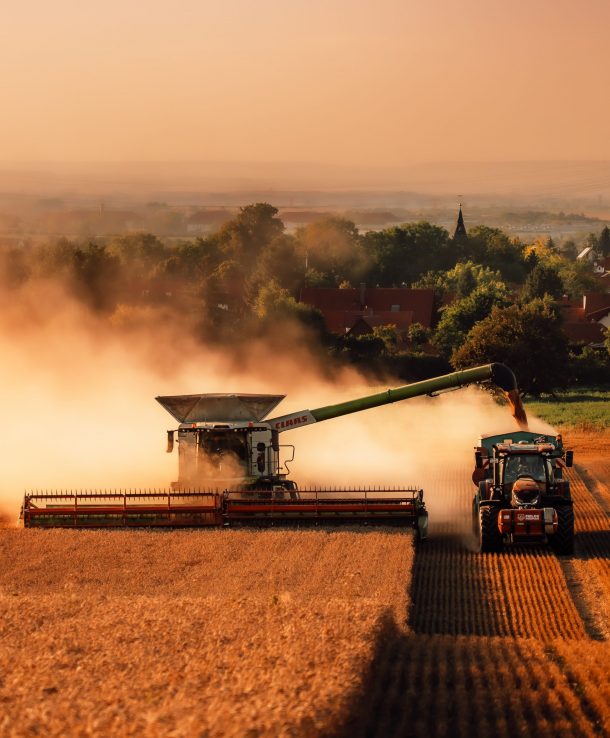
Agriculture combines the benefits of an inflation-protected tangible asset with ongoing cash flows from cultivation or lease income and complements any portfolio as a diversifying stabilizer with an attractive risk-return profile. In addition, owning land opens opportunities to realize projects in renewable energy, significantly enhancing income potential.
Agriculture is one of the oldest and most forward-looking investment forms. It links real asset value with sustainable use and offers both private and institutional investors stable and long-term income opportunities.
Agriculture combines the advantages of an inflation-protected tangible asset with ongoing cash flows from cultivation or leasing and complements any portfolio as a diversifying anchor of stability with an attractive risk/return profile. In addition, owning land opens up opportunities to realize renewable energy projects and thus significantly increase sources of income.
As the world population grows and the wealth of the global middle class increases, so does the demand for high-quality agricultural products. At the same time, the available arable land worldwide is decreasing due to land sealing, making land a long-term attractive investment.
Salm Global Land invests specifically in arable farms. Depending on the location and investment strategy, these are either managed operationally or leased on a sustainable basis. Our aim is to secure the long-term profitability of the land and develop additional sources of income, for example through the use of wind and solar energy. When selecting suitable investment locations, we attach particular importance to the following criteria:
Stable legal frameworks are found especially in parts of Central and Northern Europe, North America, and Oceania, while some regions in South America, Africa and parts of Eastern Europe are assessed as less suitable due to higher risk.
High legal certainty is offered above all locations in Central and Northern Europe, North America and Oceania, parts of South America, Africa and Eastern Europe due to political risks and weak property protection are classified as unsuitable.
Climate is a key driver of agricultural productivity, stability and value growth. Fertile soil, a stable water balance, reliable rainfall and favorable temperatures are essential for long-term yields and soil quality. Before any investment decision, relevant climate parameters are thoroughly examined, including natural soil fertility, groundwater levels, rainfall distribution, temperature cycles and the risk of extreme weather events.
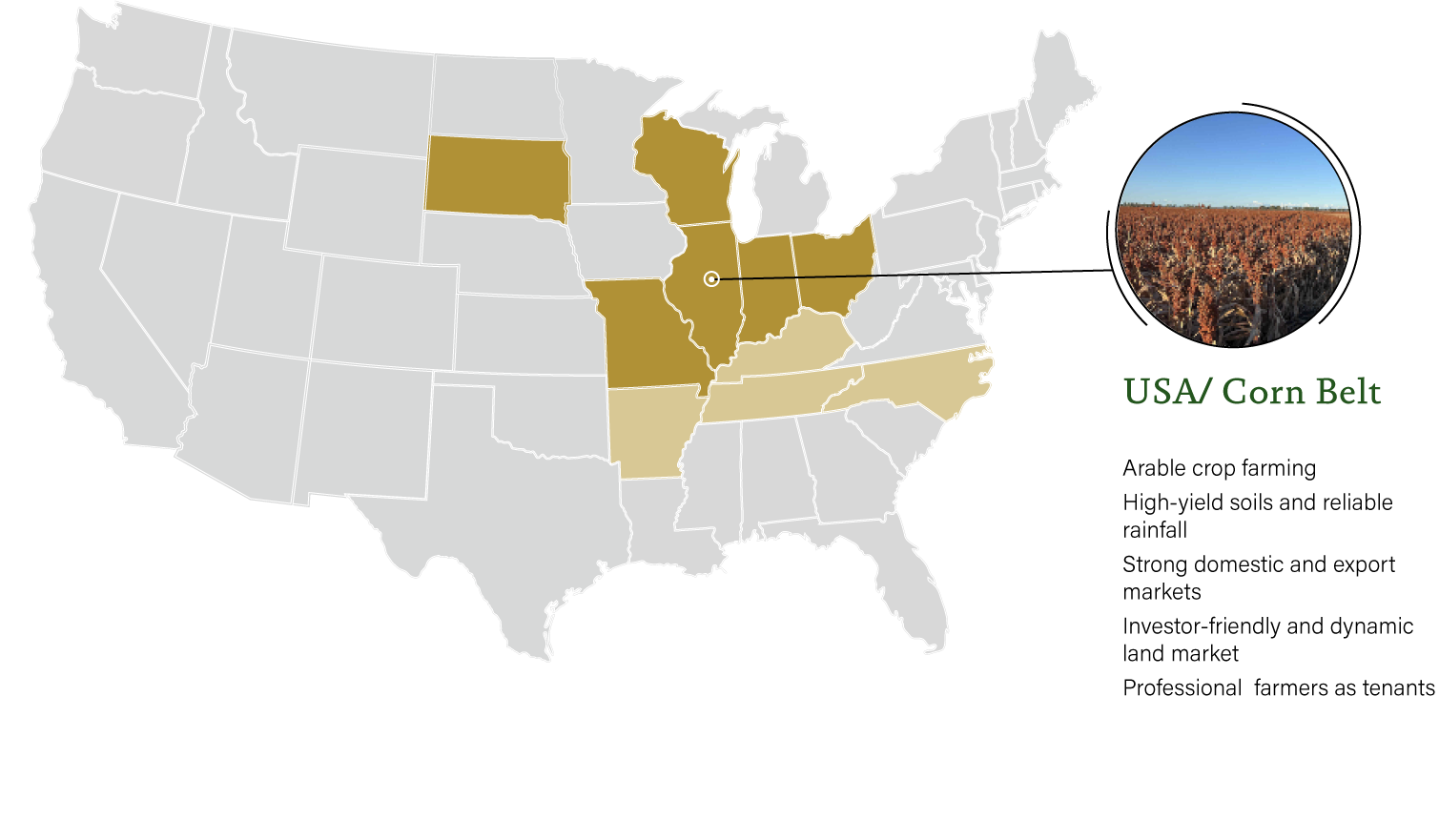
Very good agricultural growth conditions are found, for example, in the core regions of US agriculture (such as the Corn Belt and northern Great Plains), selected areas of Central and Northern Europe with high soil quality, and in parts of Oceania.
A developed and stable sales market is crucial for successful agricultural investments. Attractive regions are those with strong domestic demand and access to export markets.
Transparent market structures with reliable pricing and established value chains strengthen long-term prospects. For example, North America offers a large and liquid domestic market, while Australia and New Zealand benefit from export-oriented markets.
In Europe, strong domestic demand is present, although regulation and subsidies can influence pricing.
The entry price for agricultural land is a central factor for long-term profitability. Attractive locations are characterized by fair, market-based land prices in transparent market environments.
Regions with excessively high prices – such as parts of Western Europe with relatively illiquid land markets – may offer limited potential for value increase and longer payback periods.
Before making an investment decision, historical and current land price trends are analyzed to avoid overvaluation and to identify attractive valuation levels.
Well-developed infrastructure is essential for successful agricultural investments. It ensures efficient transport of agricultural products from field to processing and end markets, and reliable access to machinery, inputs and services.
Key factors include robust road networks, access to ports and rail, modern storage and processing facilities, and availability of skilled labor.
Regions such as North America, Oceania and Northern Europe generally provide robust infrastructure, while infrastructure in parts of Africa, South America or Eastern Europe may be less developed and can lead to higher costs, longer transport times and potential quality losses.


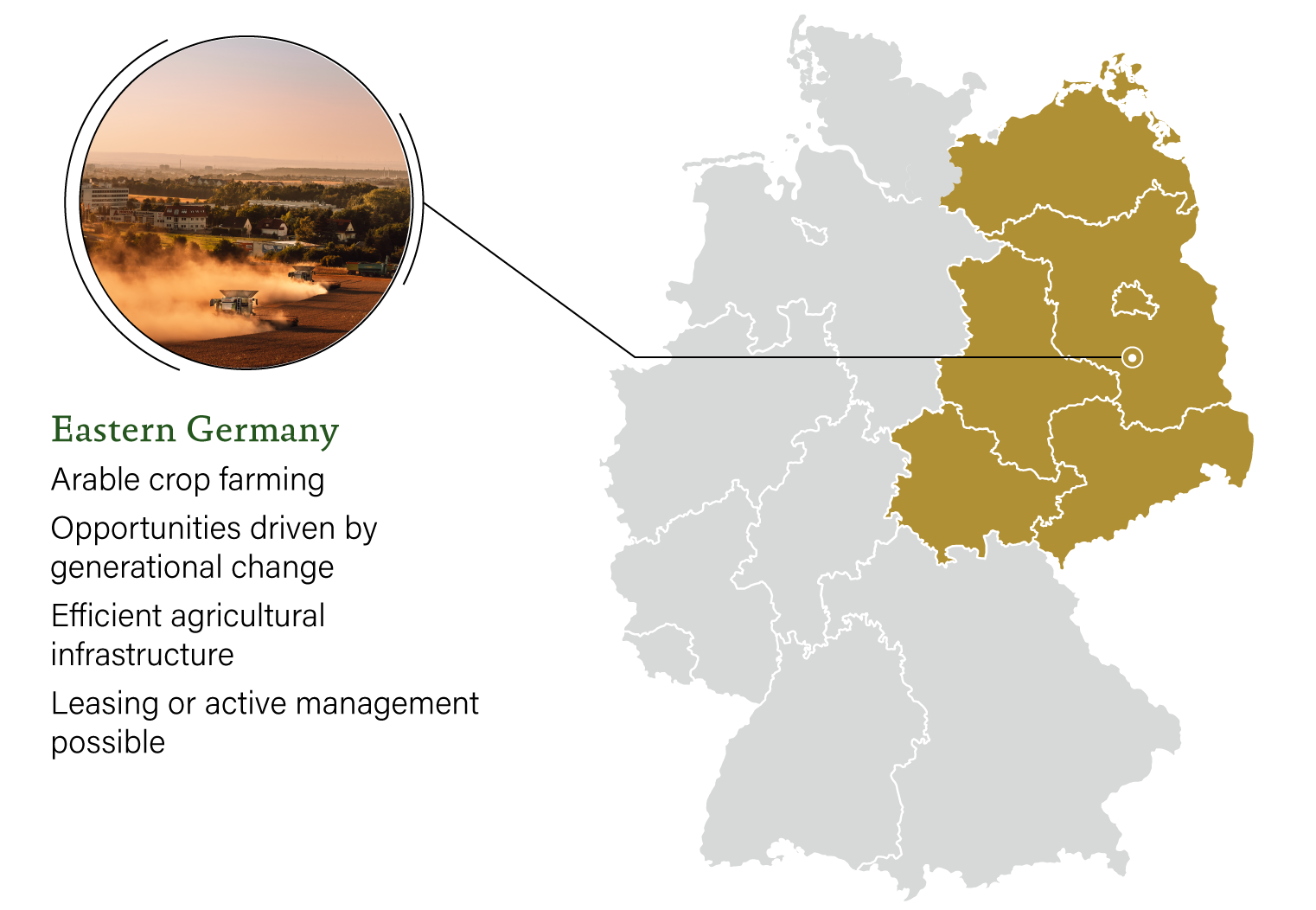
In the new federal states, the generation change among retiring pensioners opens opportunities to acquire large, established agricultural enterprises. Our focus is on acquiring and managing these operations long-term. We take over local management with a focus on crop production and aim to build sustainable, high-performing units with stable cash flows. A special emphasis is on developing renewable energy projects on suitable land.
The United States has the world’s largest and most transparent land market. Here there are opportunities to build a diverse, high-quality land portfolio. Local farmers are actively seeking external capital, and we use this environment for targeted investments. Our strategy is to support acquisition and long-term management of agricultural enterprises, especially in regions from the Lake States to Arkansas, through local presence and partnerships with experienced farmers to whom the land is leased.
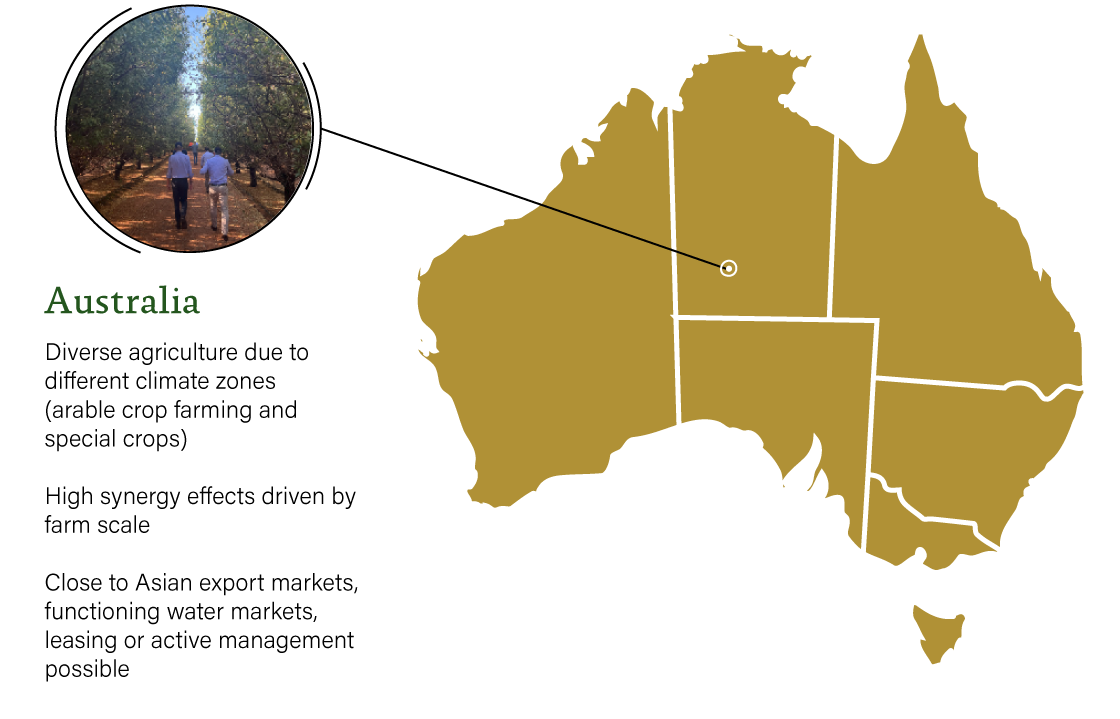
Australia has very different climatic conditions due to the size of the country. This leads to very diverse agriculture and includes the cultivation of traditional cash crops such as wheat through to specialty crops such as nut or fruit trees. This is always combined with a highly efficient use of water.
We use this environment to diversify larger portfolios and build visibility in the demand markets of Oceania/Asia. To this end, we cooperate with experienced farmers to whom the land is leased and support them in its management.
In Australia, the coastal regions of Western Australia, New South Wales, Queensland and Victoria are particularly suitable.
To provide you with an optimal experience, we use technologies such as cookies to store and/or access device information. If you consent to these technologies, we may process data such as browsing behavior or unique IDs on this website. If you do not give or withdraw your consent, certain features and functions may be impaired.